Conjunction (Basic ㊦ 177)
After/since a point in time at which something takes place.
Equivalent: After; having done something; since (time)
| Vてから | 話してから | After talking |
| 食べてから | After eating |
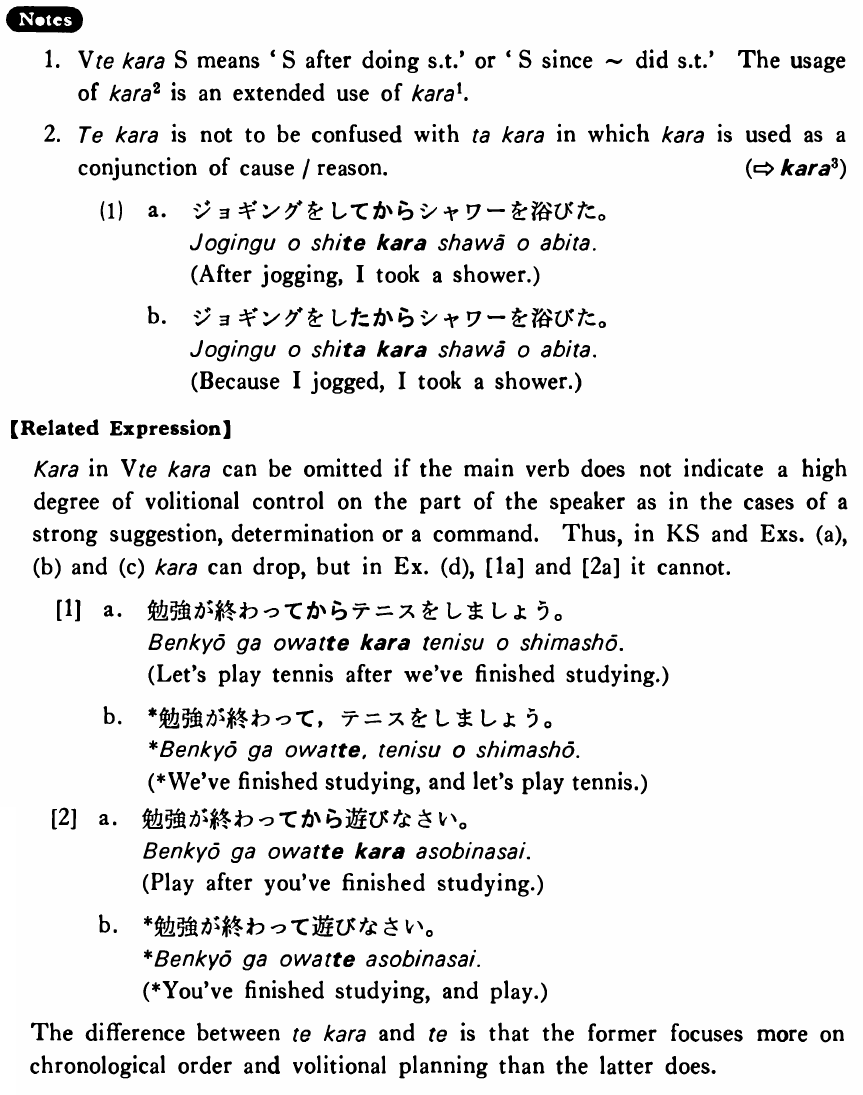
1. Verbてから Sentence means 'Sentence after doing something' or 'Sentence since ~ did something'. The usage of から2 is an extended use of から1.
2. てから is not to be confused with たから in which から
is used as a conjunction of cause/reason.(⇨ から3)
【Related Expression】
から in Verbてから can be omitted if the main verb does not indicate a high degree of volitional control on the part of the speaker as in the cases of a strong suggestion, determination or a command. Thus, in Key Sentence and Examples (a), (b) and (c) から can drop, but in Example (d), [1a] and [2a] it cannot.
[1]
[2]
The difference between てから and て is that the former focuses more on chronological order and volitional planning than the latter does.